
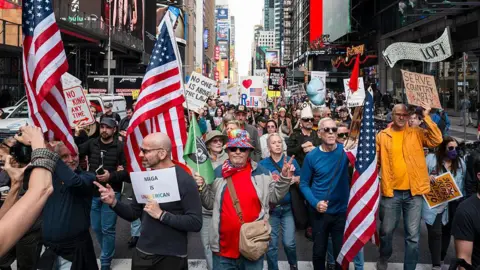
This weekend's 'No Kings' movement protests attracted an estimated multitude of participants across the United States to protest Donald Trump's presidential initiatives and his willingness to test the limits of executive power.
This served as a occasion for aligned liberal voters, progressive individuals and certain GOP critics to rally together at a moment when the American left has minimal official authority in Washington leadership.
But how should they proceed at this point?
Huge Participation Exceeds Expectations
By most accounts, the attendance at the weekend's events - in prominent metropolitan areas like the Windy City, New York, Washington DC and Los Angeles, as well as numerous lesser communities – was higher than projected and outdid the first anti-monarchy protest in the summer.
Congressional Republicans had alerted that the demonstrations would be unpatriotic, and various right-leaning executives had positioned their police forces and state militias on readiness in instance of unrest.
The enormous demonstrations proved to be non-violent – a festival, rather than violence. In Manhattan, there were no protest-related arrests, and the assembly in DC included households and young children.
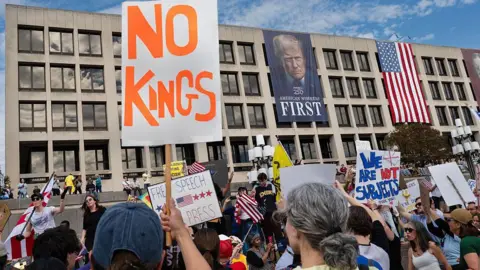
"At present all across America in numbers that could surpass any previous occasion of demonstration in our American legacy, the people are proclaiming clearly and confidently that we are a independent citizens, we are not a society that can be ruled, our leadership is not for sale," a leading legislator declared in his speech to the Washington DC rally.
White House Response and Governmental Consequences
Nearby from the anti-monarchy rally in the nation's capital, the executive branch answered the demonstrations with mockery.
"Why bother," an administration spokesperson stated in answer to numerous journalist requests about the protests.
The president shared several computer-created recordings on his digital channel of him displaying a monarch's symbol, showing an example where he was flying a aircraft that dumped what appeared to be human waste on the demonstrators.
While Republicans may be minimizing the impact of the protests, the scale of the attendance – coupled with the administration's predominantly negative public support in leading opinion polls - suggests a liberal chance to recover from the previous year's election losses.
Democratic Obstacles and Internal Splits
Democrats yet encounters a long way to go to make progress, nevertheless.
Research suggest only a 33% of Americans support it - the lowest for decades - and party members are disagreeing over ways to mount an successful challenge to the president when they have lost either chamber of the Capitol.
Left-leaning individuals took to the streets on Saturday for a variety of reasons. Trump's aggressive border policies, his tariff policies, his spending reductions, his international relations, his deployment of National Guard in metropolitan areas and his tradition-defying use of presidential authority were all common subjects of concern and indignation.
Some of the discontent was additionally aimed at Democratic leaders.
"We continue suffering losses, and we're not speaking out," a particular march attendee in Washington DC stated to news organizations on the weekend. "Understand, I feel we must be more aggressive. Sadly, the high road is ineffective."
Government Shutdown Tactic and Political Perils
Liberal legislators have been increasingly confrontational over the ongoing government shutdown, which is nearing its four-week mark. They have been unwilling to endorse a temporary extension of current government funding without a bipartisan agreement to resolve medical coverage support for financially struggling individuals scheduled to end at the end of the year.
Due to legislative procedures, Democratic senators have some power although being in the minority – and, to date, the general population seems to be assigning comparable blame for the stalemate to the administration and the Republican majority.
Yet the approach comes with risks as well. The pain from the closure – notably for those in the Democratic coalition – is likely to intensify as the weeks progress.
Various government employees have been denied wages and are facing monetary struggle. Monetary resources is projected to end for nutrition assistance. The justice department is reducing its functions. And the Trump administration is utilizing the closure to mandate new decreases to the federal workforce and suspend national expenditures, targeting liberal-leaning regions and metropolitan areas.
Upcoming Elections and Political Outlook
The situation is that Democratic leaders in the Senate will finally have to discover a resolution of the crisis. But they may be challenged to achieve agreements that the protesters who took to the streets on the weekend will support.
"If|In case|


